Although Everton reached two domestic cup semi-finals in
2015/16 (something the club had not done since 1984), their performances were
disappointing in the Premier League, as they finished 11th for the second
successive season. As chairman Bill Kenwright observed, “Ultimately, our final
league positions over the last two seasons were not good enough.”
This culminated in the decision to sack manager Roberto
Martinez, replacing him with former Dutch international Ronald Koeman, who was
tempted to leave Southampton for the project at Everton.
This was a clear statement of intent by new majority owner,
Farhad Moshiri, an Iranian billionaire, who bought a 49.9% stake in the club
for a reported £85 million in February 2016 after selling his Arsenal
shareholding to business partner Alisher Usmanov.
Moshiri explained his managerial choice thus, “For our club
to compete in the north-west of England, which is the new Hollywood of football
with Guardiola, Mourinho, Klopp, we needed a star to stand on the touchline, so
I got Koeman.”
The club also brought in a new director of football in the
shape of Steve Walsh, who had been responsible for some astute player
recruitment at surprise champions Leicester City by scouting the likes of Riyad
Mahrez, N’Golo Kanté and Jamie Vardy.

"Rom, if you want to"
Everton had been looking to secure new investment for many
years, but Kenwright is convinced that he has found the perfect investor: “I’m
more positive now about the future of our great club than I’ve been during my
time as Chairman. I have absolutely no doubt that in Farhad Moshiri we have
found someone not only with the wherewithal - and we all know how important
that is these days - but also with a deep understanding of the game and a
growing appreciation of all things Everton.”
This new investment is key to Everton’s future prospects and
should represent a substantial change after years of caution and thrift.
Certainly, Moshiri is talking a good match: “The way to compete is to build a
big stadium, to increase our merchandising and commercial income. That is what
we will do.”
He added, “We needed a strong balance sheet, so I paid off
the debts. We are now very flexible financially. We have no restrictions to
spend.”
Before his departure, the ebullient Martinez said, “financially
we can compete against anyone in world football”, which seemed a bit
over-the-top, but for the first time in ages Everton do appear to have a solid
plan. As part of the new strategy, Moshiri will clearly make funds available to
strengthen the squad, which will give the Blues a fighting chance on the pitch.

The need for new investment was highlighted by the
publication of Everton’s financial results for the 2015/16 season, which
included a hefty loss of £24.3 million, considerably higher than the previous
season’s £4.6 million, though the bottom line was adversely impacted by a
significant £11.3 million exceptional
payment “to former employees and other costs in relation to the change in
coaching staff in the year”.
This obviously
included paying out the remainder of Martinez’s contract. It is not clear
whether the reported £5 million compensation paid to Southampton to secure
Koeman’s services is also included, but my guess would be that will only be
reflected in next year’s figures, given that the Dutchman signed his Everton
contract on 14 June, i.e. after the 2015/16 accounts were closed. Furthermore,
Martinez’s pay-off was reported in the media to be in the region of £10-12
million.
Revenue fell £4 million (3%) to £121.5 million from a record
£125.6 million in 2014/15, when Everton reached the last 16 in the Europa
League. This contributed to commercial income decreasing by £4.6 million (18%)
to £21.4 million, as the club “missed out on performance bonuses from its
partners and commercial revenues from UEFA.”

"Have I told you, Leighton?"
The absence of European football also meant that gate
receipts were £0.3 million (2%) lower, though this was largely offset by
reaching the semi-finals of the FA Cup and Capital One Cup. Broadcasting income
was slightly higher at £82.5 million, due to Everton being shown live one more
time.
Costs continued to grow with the wage bill rising £6.5
million (8%) to £84 million and player amortisation up £3.3 million (17%) to
£22.4 million. Other expenses also increased by £1.5 million to £30.4 million.
In contrast, profit on player sales rose £4.5 million to
£7.8 million, while net interest payable was £2.7 million lower at £3.7
million. It should be noted that the 2014/15 interest was restated following
the transition to Financial Reporting Standard 102.
These financials were noting to write home about, as
confirmed by chief executive Robert Elstone, “The results reflect a challenging
year for the club. Performance on the pitch directly impacted commercial income
with key deals reduced as a result of the club’s finishing position.”

Traditionally, football clubs have lost money, but the
environment has largely changed in the Premier League these days, thanks to the
combination of surging TV money and Financial Fair Play regulations, which has
meant that top-flight English clubs have never been richer.
In fact, Everton are one of only two clubs that have so far published
2015/16 accounts that have reported a loss. The other one is Chelsea, and they
would also have been profitable without £75 million of exceptional payments
(mainly the termination fee for their shirt sponsorship deal).
At the other end of the spectrum, we find the two Manchester
clubs with United and City announcing healthy pre-tax profits of £49 million
and £20 million respectively. The other Premier League clubs that have released
2015/16 accounts to date were also profitable: Norwich City £13 million,
Arsenal £3 million and Stoke City £2 million.
This continues the trend of the 2014/15 season, when only
six of the 20 Premier League clubs made losses. This group largely comprised
clubs that have been badly run (Aston Villa, Sunderland and QPR), but also
included Chelsea, Manchester United and, yes, Everton.

In fairness, one of the drivers for Everton’s poor financial
performance has been the lack of profits from player sales. This activity can
have a major influence on a football club’s bottom line, as shown in 2014/15 by
Liverpool (£56 million) and in 2015/16 by Chelsea (£49 million).
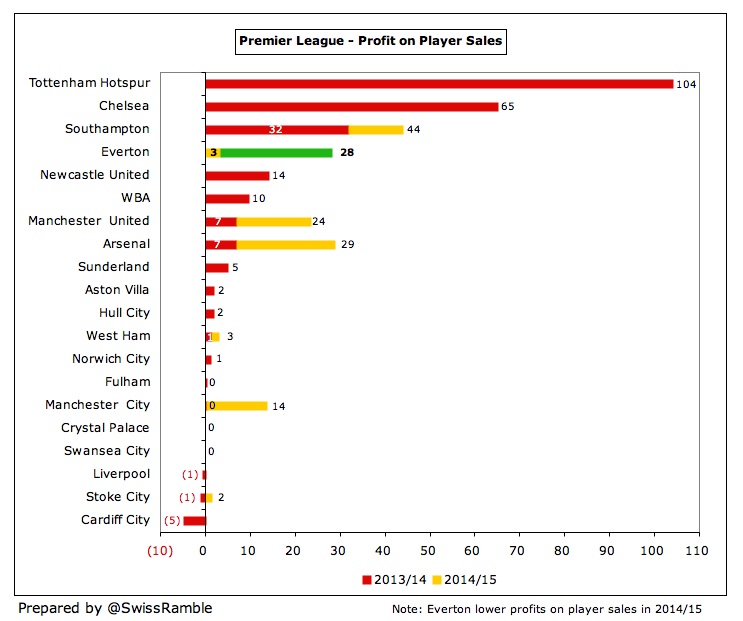
In contrast, Everton only generated £8 million of profit
from this activity, mainly due to the transfer of Steven Naismith To Norwich
City, though this was higher than the £3 million reported in 2014/15.

Of course, Everton have more often than not lost money,
reporting losses in eight of the last 11 years. They were consistently
loss-making between 2006 and 2012 (with a cumulative £45 million loss in those
seven years), though they did at least restrict their annual losses to
manageable levels. There was then some improvement in 2013 and 2014 before a
return to losses in 2015 and 2016.
As we have seen, this is partly due to the declining impact
of player sales in the last two seasons. Indeed, the £28 million profit in 2014
was almost entirely down to the sale of Marouane Fellaini to Manchester United.
It is fair to say that in many years Everton have effectively subsidised their
underlying deficit with the sale of a major player, despite Kenwright claiming
that Everton are “not a selling club.”

Over the last decade, Everton’s aggregate loss before tax
was £33 million, but this would have been significantly worse without £113
million of profits from player sales in the same period.
Next year’s accounts will benefit from the £47.5 million
sale of defender John Stones to Manchester City, which will help Everton swing
back into the black (along with the additional money from the new TV deal).
The club has noted that the balance sheet “substantially
undervalues” players such as Romelu Lukaku and Ross Barkley, especially as no
cost is ascribed to home grown players. Of course, Everton would almost
certainly want to retain such talent, but they would boost their profits if
they were to sell.

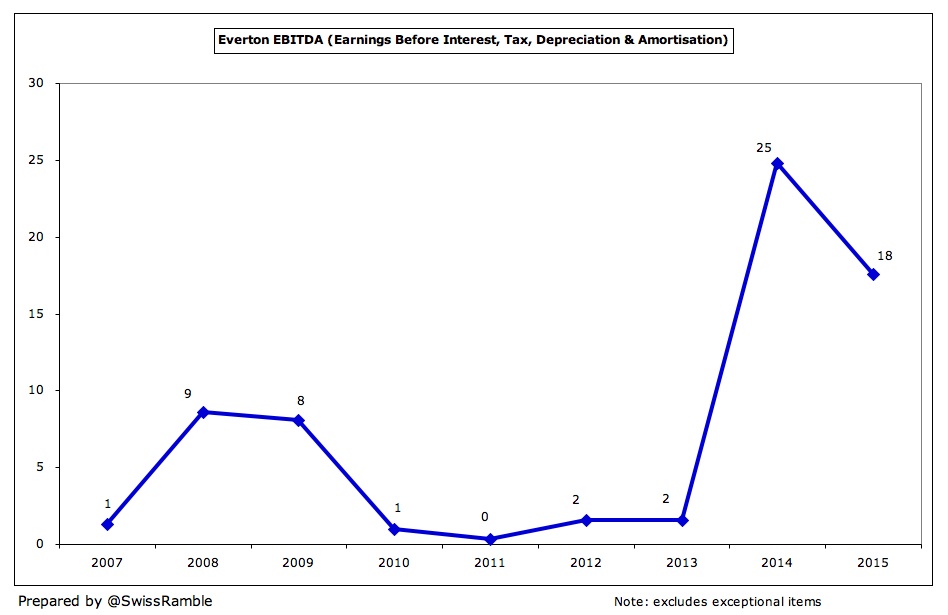
To get an idea of underlying profitability and how much cash
is generated, football clubs often look at EBITDA (Earnings Before Interest,
Depreciation and Amortisation), as this metric strips out player trading and
non-cash items.
In Everton’s case this highlights their operational
difficulties in the past two seasons, as their EBITDA has fallen from £25
million in 2013/14 to just £7 million in 2015/16 (excluding exceptional
payments). The major improvement in 2014, following many seasons of cash
break-even, was largely due to the first year of that Premier League TV deal
three-year cycle, so we could anticipate a similar jump in 2016/17 with the new
TV deal – at least £9 million based on the operating profit projection at
Everton’s AGM.

This is much-needed if we look at EBITDA in the Premier
League, which shows that Everton are a long way behind the elite with Manchester
United leading the way with an astonishing £192 million, followed by Manchester
City £109 million and Arsenal £82 million. In other words, United’s cash profit
is an incredible 27 times as much as Everton’s.
The only Premier League clubs with lower EBITDA than Everton
were Stoke City, Sunderland, Swansea City and Aston Villa, which is a shocking
state of affairs for a club of Everton’s history. No wonder that Moshiri has
been welcomed with open arms, as he will definitely grow the club’s revenue.

Everton made great play of the fact that 2015/16 was the
“third successive year we posted turnover in excess of £120 million.” That’s
one way of looking at it, but another less charitable view would be that
revenue has essentially been flat for the last three seasons.
Since 2013 revenue has grown by £35 million (41%), though
most of this is down to the increasing TV deal (£27 million), which is thanks
to the central Premier League negotiating team, as opposed to the club’s board.
In fairness, commercial revenue has grown by £8 million in this period, while
gate receipts were unchanged at just under £18 million (though this is a bit
misleading, as it does not take into consideration the club’s restatement of
the revenue categories in 2014).
At the recent AGM Everton projected revenue of £172.5
million in 2016/17, a year-on-year increase of £51 million, almost all of which
is driven by the new Premier League broadcast deal. The club’s challenge has
been to differentiate itself from other clubs by growing commercial income.
Although they have been unsuccessful in the past, Moshiri will surely change
that for the better.

The importance of revenue growth is clear when we compare Everton’s
£122 million to the Premier League elite, e.g. Manchester United earned more
than half a billion, which is almost £400 million higher than the Blues. That’s
an enormous financial advantage – every season.
In fact, the top four clubs all earn well above £300
million: United £515 million, Manchester City £392 million, Arsenal £351
million and Chelsea £329 million, while Liverpool and Tottenham generated £298
million and £196 million respectively in 2014/15. Little wonder that Moshiri
referred to “a mini league emerging this year of six clubs”
Although it could be argued that Everton are not doing too badly
in revenue terms, as they are the 8th highest in the Premier League, there is a
distinct bunching of clubs in the £100-120 million range. In other words,
Everton’s financial advantage over the other clubs is nowhere near as much as
their disadvantage compared to the top six.
Moshiri acknowledged this when speaking about Koeman’s
objectives: “He achieved eighth and seventh with Southampton. He needs to
improve on that, but it is a very difficult landscape now.”
One point worth noting is that Everton’s revenue would be
around £8 million higher if the gross revenue from the outsourced catering and
kit deals were to be added back.

On the bright side, Everton had the 18th highest revenue in
the world in 2014/15, which represented the club’s joint highest position in
the Deloitte Money League. That’s obviously a fine accomplishment, but it does
not really help Everton much domestically, as no fewer than 17 Premier League
clubs feature in the top 30 clubs worldwide by revenue.
As Deloitte observed, “This is again testament to the
phenomenal broadcast success of the English Premier League and the relative
equality of its distributions, giving its non-Champions League clubs
particularly a considerable advantage internationally.”

One technical aside: Everton include the commercial elements
of TV deals within commercial income, even though most other clubs classify it
as broadcasting income, and Deloitte have duly reduced commercial and increased
broadcasting (though the total revenue is the same).

All these reclassifications make it difficult to analyse
Everton’s revenue mix, but a couple of things are clear. First, match day has
become progressively less important with only 15% of total revenue coming from
this stream. Second, like so many Premier League clubs, there is huge reliance
on TV money, which generates just under 70% of their turnover.

That might sound a little concerning, but it is fairly
common business model in the Premier League. For example, in 2014/15 nine clubs
actually had a greater reliance on TV money than Everton, with three of them
(Burnley, Swansea City and WBA) earning 80-85% from broadcasting. This
dependency will further increase with the blockbuster 2016/17 deal.
In 2015/16 Everton’s share of the Premier League TV money
rose 3% (£2 million) from £81 million to £83 million, due to being broadcast
live on one more occasion (18 vs. 17). The distribution of these funds is based
on a fairly equitable methodology with the top club (Arsenal) receiving £101
million, while the bottom club (Aston Villa) got £67 million.

Most of the money is allocated equally to each club, which
means 50% of the domestic rights (£21.9 million in 2015/16) and 100% of the
overseas rights (£29.4 million). Merit payments (25% of domestic rights) are
worth £1.2 million per place in the league table and facility fees (25% of
domestic rights) depend on how many times each club is broadcast live.
There was also £4.5 million of commercial revenue awarded to
all Premier League clubs, though I suspect that Everton might have reported
this within commercial income, even though most other clubs classify it as
broadcasting income. This would help explain why Everton’s total broadcasting
income in the accounts was only £82.5 million, even though their Premier League
distribution was £83.0 million.

"The Liberty of Mason Holgate"
Either way, Elstone was right to draw attention to the new
TV deal stating in 2016/17: “We are also benefiting from the increased revenues
under the significant new broadcast deal” The AGM projected an increase in
broadcasting income to more than £130 million, based on 55% growth in the
Premier League deal (70% domestic and 40% overseas). The importance of success
on the pitch was also emphasised, as each league place under the new deal would
be worth an additional £1.9 million, compared to £1.2 million for the previous
deal.
Former Everton manager Roberto Martinez welcomed the new TV
deal, as he believed that it would give the middle-tier clubs greater chance of
success: “The new television contract has given an opportunity to every club to
do something different. They can look at themselves, thinking this is the first
time that we have been able to spend a certain amount of money, and suddenly
you develop a belief that allows you to be competitive.”
Another way of looking at this is that Everton earned more
from broadcasting in 2014/15 than Bayern Munich, Borussia Dortmund, Atletico
Madrid, Roma, Milan and Paris Saint-Germain – even before the £45-50 million
increase in 2016/17.


Everton have only qualified once for Europe in recent years,
earning €7.5 million from the Europa League in 2014/15. This was a lot less
than the €20.9 million that Tottenham received for reaching the same stage the
following season.
Not only did the new UEFA television deal deliver 38% more
money in 2015/16, but a greater proportion was allocated to the Europa League,
so that prize money for this competition shot up by 71% (even though the
rewards are still much higher in the Champions League).

Regular qualification for Europe would be highly beneficial
for Everton, as can be seen by the money earned by English clubs over the last
season. Chelsea lead the way with €253 million, largely thanks to their
Champions League triumph in 2012, but maybe a better comparative would be
Liverpool, who earned €77 million in this period, i.e. €69 million more than
Everton.
This only relates to the broadcasting income, but additional
revenue would also come from more gate receipts and higher commercial income
via success clauses in commercial deals.

Everton’s gate receipts fell by £0.3 million (2%) from £17.9
million to £17.6 million in 2015/16, largely due to the absence of European
competition, though the impact of this lost revenue was reduced by increased
revenue form reaching the semi-final of both domestic cup competitions compared
to third round exits in 2014/15.
The average attendance fell slightly to 38,132, though this
was only the second time in 20 years that consecutive seasons posted averages
above 38,000. Moreover, this season attendances have rebounded above 39,000,
which would be the highest attendance since 2003/04.


Elstone commented, “We’re delighted to be projecting an
average gate in excess of 39,000. We look set to be full for every game in
2016/17. Of course, the reason we’re full is almost 32,000 season ticket
holders.”
This is partly due to Everton’s admirable commitment to
affordable pricing. The club froze ticket prices in 2015/16, while they
actually reduced all season ticket prices by 5% for the 2016/17 season,
representing a free game compared to the previous season.
They have continued this trend by announcing that all season
ticket prices will be reduced or frozen for the 2017/18 season and have
introduced a 12-month payment option. The maximum season ticket price is £565,
ensuring that no adult will pay more than £30 a game. There is also a new £380
season ticket for 22-24 year olds, so youngsters will only pay £20 a game.


Elstone explained the club’s philosophy: “We feel confident
that our current pricing structure represents great value for money and holds
up well when compared to our rivals. Most importantly, it makes football at
Goodison affordable for young fans.”
As a result of these pricing initiatives, Everton’s match
day revenue of £18 million will continue to lag behind the top six clubs:
Manchester United £107 million, Arsenal £100 million, Chelsea £70 million, Liverpool
£59 million, Manchester City £53 million and Tottenham £41 million.
Elstone confirmed the impact on the financials, “The outcome
of this affordable pricing strategy is a significant drop in what we generate
from each seat for each game”. However, he added, “We were conscious of the
substantial uplift in the value of our media rights next season.”


"Working for the Yannick Dollar"
Of course, a new stadium would be a game changer for
Everton. It would be a wrench to leave Goodison Park, one of the most
atmospheric grounds in England, but it is simply not fit-for-purpose in the
modern era with its limited capacity and inadequate facilities.
As Moshiri said, the club needs a new stadium that “rewards
the loyalty and passion of our fans.” He continued, “We need a big stadium, no
question about it. We have done the hard bit, because the club was restricted
to move or expand Goodison by banking covenants, but I have paid the debts, so
we are free to do what we want and we have the finances to do it.”
There have been a few false dawns with three other proposed
stadium moves coming to nothing: first King’s Dock in 2003, then “Destination
Kirkby” in 2009, most recently Walton Hall. However, it now feels like it could
really happen.


"Enola Gueye"
There are two potential sites: Bramley Moore Dock and Stonebridge
Cross in Croxteth. The dock site is clearly the club’s preferred option, as
confirmed by Mayor Joe Anderson at Everton’s AGM, “Everybody in this room wants
the waterfront site. This is the most exciting opportunity this club has had in
decades.”
Elstone also favoured this site, though he did sound a note
of caution: “The opportunities are much greater at that site, but so are the
costs. We have to find answers to some of the uncertainties and risks, because
it is the biggest decision the club will ever make.”
He continued, “(There has been) solid progress on many
fronts, most encouragingly in our partnership with Liverpool City Council and
its desire to support our efforts to find the money to make the stadium viable.
We are optimistic about the new stadium prospects. It’s an optimism tempered by
some significant issues that need to be resolved before we can move forward.”
The final word (for now) on the new stadium goes to Moshiri,
which is fair enough, as he may well end up funding most of the required £350
million plus: “In our mind, we know where we want to go. We are committed.”


Everton’s reported commercial income dropped 18% (£4.6
million) from £26.0 million to £21.4 million in 2015/16, comprising £9.3
million for sponsorship, advertising and merchandising plus £12.1 million for
other commercial activities. The fall was due to the absence of commercial
revenue from the Europa League.
As we saw earlier, it is not completely clear what the club
has included within commercial income and the Deloitte like-for-like figure for
2014/15 was adjusted downwards to £20.1 million, as they excluded the
“commercial” element of broadcasting income. This meant that Everton had the
lowest commercial revenue of any club in the Money League Top 20.
That said, the comparisons are a bit misleading, as Everton
have outsourced their catering and kit deals. If they were to report these
revenues gross (like most other clubs), their commercial income would rise by
£8 million.


"Don't cry for me, Argentina"
Whatever it consists of, Everton’s commercial income of £21
million pales into insignificance compared to heavyweights such as Manchester
United, who generate an amazing £268 million from this activity. That
comparison might be a little unfair, but it is worth noting that Tottenham
earned £60 million (in the 2014/15 season).
It is clear that Everton need to address their commercial
shortcomings, as Elstone acknowledged, “We will continue to look for growth in
all areas, in particular, as we approach the mid-point of the final year of the
current Chang partnership, with a clear focus on our main sponsor opportunity.”
It is therefore very encouraging (“great news” per Elstone)
that the club has “signed up £75 million in new revenues” in the past few
weeks. The chief executive noted that the two deals already finalised will run
over a five-year period, implying £15 million a year.
Elstone spoke of “a 300% increase in the value of our shirt
sponsors”, which would suggest that the new deal would be worth £21.2 million a
year, given that the current deal with Thai beer producer Chang is worth £5.3
million a year (£16 million over three years).


That would represent a notable increase, but there have been
some suggestions that Elstone’s comments could have been misconstrued, e.g. if
the 300% increase referred to the total value of the deal, that would imply £64
million over five years, meaning an annual value of £12.8 million. My guess is
that the increase refers to the combined value of the front of shirt and
additional sleeve sponsorship, but we should soon know.
Either way, it’s solid progress on the commercial front with
talk of Kenyan online sports betting firm SportPesa being the new shirt
sponsor. One possibility for a more lucrative deal would be to give the new
partner first refusal on stadium naming rights.
Encouraging stuff, but to place this into perspective, the
leading clubs have secured much higher shirt deals: Manchester United
(Chevrolet) £56 million, Chelsea (Yokahama) £40 million, Arsenal (Emirates) £30
million, Liverpool (Standard Chartered) £25 million.
The club has also announced a significant new sponsorship
deal for the Finch Farm training ground and academy. This is with USM Holdings,
the holding company of Alisher Usmanov, Moshiri’s business partner. The fact
that Usmanov is helping out his mate has raised some eyebrows, as the Russian
remains an Arsenal shareholder, and it is likely that the deal would be reviewed
for “fair value” by UEFA (assuming it is deemed a “related party” transaction)
if Everton qualify for Europe.


Everton’s kit supplier deal with Umbro was described as a
club record and is reportedly worth £6 million a season, which would be twice
as much as the previous Nike contract, though the accounts suggest that it
might not be so high in reality.
This is again a long way behind the deals at other clubs,
e.g. Manchester United (Adidas) £75 million, Chelsea (Nike) £60 million,
Arsenal (Puma) £30 million, Liverpool (New Balance) £28 million.
It will also be interesting to see if Moshiri reviews the
10-year Kitbag deal, which provides a guaranteed £3 million a year plus
royalties for running the retail operation. Elstone has described this as a
good arrangement that “de-risks Everton in a notoriously difficult business
sector”, but it does betray a lack of ambition.


Everton’s wage bill rose 8% (£6.5 million) to £84 million,
following continued investment in the squad, with the additions of Tom
Cleverley, Aaron Lennon, Ramiro Funes Mori, Gerard Deulofeu and Mason Holgate.
In addition, new contracts were awarded to James McCarthy, Kevin Mirallas, Mo
Besic, Brendan Galloway and Bryan Oviedo.
Furthermore, the average number of employees increased from
274 to 315, including playing, training and management up from 98 to 108, youth
academy up from 38 to 47, marketing and media up from 32 to 41 and management
and administration up from 71 to 81.

The wage growth increased the wages to turnover ratio from 62% to 69%. Elstone said that this was still “below the Premier League average”, which does not seem to be the case based on reported figures, though it is accurate if we add back the outsourced commercial revenue, which reduces Everton’s ratio to 65%.

The wage growth increased the wages to turnover ratio from 62% to 69%. Elstone said that this was still “below the Premier League average”, which does not seem to be the case based on reported figures, though it is accurate if we add back the outsourced commercial revenue, which reduces Everton’s ratio to 65%.
Following last season’s growth Everton’s wage bill is
essentially “best of the rest”, i.e. the highest of those clubs outside the top
six. However, it is still dwarfed by the elite clubs: Manchester United £232
million, Chelsea £222 million, Manchester City £198 million and Arsenal £195
million.


This disparity was noted by Koeman: “We have a lot of
ambition and we like to do the best that is possible. But you have to look to
the big clubs with the possibilities and the players they have. Nobody expected
Leicester to win last season, but that will not happen again.”
Clearly, Moshiri will try to increase the wage bill to
better compete. Indeed, Elstone has already advised, “Projected wages are set
to increase significantly in the current season, reflecting a further
commitment to player recruitment and new contracts for existing players.” The
AGM forecast a wage bill of £111 million for 2016/17, an increase of £27
million.
However, Everton will need to consider the Premier League’s
Short Term Cost controls, which restrict the annual player wage cost increases
to £7 million a year for the three years up to 2018/19 – except if funded by
increases in revenue from sources other than Premier League broadcasting
contracts, e.g. gate receipts, commercial income and profits on player sales.


One thing that is quite striking in Everton’s accounts is
the growth in other operating costs, rising from £22 million to £30 million in
the last three years without any substantial explanation.

This seems quite high for a club of Everton’s size,
especially as the retail and catering businesses have been outsourced, which
means that other operating costs should be lower than other clubs (as net
profits are reported in revenue).

Another cost that can have a major impact on the profit and loss account is player amortisation, which reflects investment in transfers. Basically the more that a club spends, the higher its player amortisation. In this way, Everton’s player amortisation has doubled from just £11 million in 2013 to a £22 million peak in 2016, reflecting increased spending in the transfer market.

The accounting for player trading is fairly technical, but
it is important to grasp how it works to really understand a football club’s
accounts. The fundamental point is that when a club purchases a player the
transfer fee is not fully expensed in the year of purchase, but the cost is
written-off evenly over the length of the player’s contract, e.g. Romelu Lukaku
was bought for a reported £28 million on a five-year deal, so the annual
amortisation in the accounts for him is £5.6 million.


Nevertheless, Everton’s player amortisation of £22 million
is not that high for the Premier League and is obviously miles behind the
really big spenders like Manchester City (£94 million), Manchester United (£88
million) and Chelsea (£71 million), though it should further increase next year
following this summer’s acquisitions.

For the period between 2009 and 2014, despite Kenwright’s
protestations, Everton were a selling club, averaging annual net sales of £7
million. However, the last three seasons have seen a return to spending, with
average net spend of £21 million, including the club’s record purchase of
Lukaku from Chelsea.
Last summer Everton splashed out £45 million to bring in
Yannick Bolasie, Ashley Williams, Idrissa Gueye and Maarten Stekelenburg,
though they recouped the outlay in one fell swoop by selling John Stones to
Manchester City. As Kenwright put it, “While we may not have finally done the
amount of business in the summer transfer window we would have liked, we still
added considerable strength and experience to our squad.”


Despite the higher spending over the last three seasons,
Everton’s net spend is still mid-table in the Premier League, a long way below
the two Manchester clubs (City £299 million and United £275 million), though it
was higher than Liverpool £55 million.
However, Everton have been one of the most active clubs in
the January transfer window, already purchasing midfielder Morgan Schneiderlin
from Manchester United for a fee rising to £24 million and 19-year-old forward
Ademola Lookman from Charlton for £11 million. They have also reportedly made
offers for Standard Liege forward Ishak Belfodil and Atalanta midfielder Franck
Kessié.


Everton’s net debt rose by £23.5 million from £31.3 million
to £54.8 million with gross debt increasing by £17.6 million from £40.0 million
to £57.6 million and cash falling by £5.9 million from £8.7 million to £2.8
million.
At the time of the accounts, the debt comprised three
elements: (a) 25-year loan of £20 million with Prudential, which bears a high
interest rate of 7.79%, leading to annual payments of £2.8 million; (b) a
short-term loan of £35 million with Rights and Media Funds Limited (formerly JG
Funding), securitised on Premier League TV money, at a 5.2% interest rate; (c)
overdraft with Barclays of £2.7 million.
This is all irrelevant now, as Moshiri provided an
interest-free loan of £80 million with no agreed repayment data after the
account were published. This was used to repay all of the external loans and to
pay the exceptional items.


Hopefully, this will bring to an end Everton’s use of opaque
loans taken out with mysterious offshore corporations that started with Vibrac,
who are based in the British Virgin Islands, though the accounts did note that
the club had secured similar funding via a facility repayable on 14 July 2017.
Everton’s debt is by no means one of the highest in the
Premier League with four clubs having debt above £100 million, namely
Manchester United £490 million, Arsenal £233 million, Sunderland £141 million
and Newcastle United £129 million.
Everton also have contingent liabilities of £35 million (£18
million dependent on future appearances and £17 million loyalty bonuses if
certain players are still with the club on specific dates), up from £20 million
the previous season.


The high interest rate on Everton’s loans has meant that
their financing costs have been among the largest in the Premier League.
Although nowhere near as much as the interest paid by the likes of Manchester
United and Arsenal, this has certainly not helped the club’s finances. The good
news is that Moshiri’s interest-free loan should save them around £5 million a
season.


This unwelcome burden is emphasised even more when reviewing
the cash flow over the last eight years. In that period, Everton generated £84
million of cash, mainly from operating activities £56 million, though this was
supplemented by additional loans (net) £18 million and the sale of the old
training ground £9 million.


Around 40% of this cash (£34 million) was required for
interest payments, which was only £7 million lower than the £41 million (net)
spent on players, leaving only £10 million on infrastructure investment.
Looking ahead, there is a sense of optimism around Everton’s
future following Moshiri’s investment. Obviously money is no guarantee of
success, but it does make it more likely.
There are still some issues with Moshiri pointing out that
the club will be somewhat restricted by FFP: “It is not the same as when
Chelsea and Manchester City began their projects, which was before Financial
Fair Play.” It’s also still not clear whether the Iranian will ultimately
become the outright owner of the club.


"Williams, it was really nothing"
However, at least the club now has stronger backing, whereas
for the past few years Everton have struggled to compete due to a lack of
financial resources. In the shape of Moshiri, they evidently have a man with a
plan, including reduction of external debt, increased commercial income and, of
course, a new stadium.
Let’s leave the last word to him: “Bill and previous
managers kept the club close to the elite for many years, but now we need to
look at a sustainable base to be among the elite. It takes time, but we are
committed, that’s why we’re here.”
He added, “It’s not enough to say you are a special club – we don’t want to be a museum. We need to be competitive and to win.”
He added, “It’s not enough to say you are a special club – we don’t want to be a museum. We need to be competitive and to win.”