Showing posts with label QPR. Show all posts

Tuesday, May 26, 2015

Queens Park Rangers - Do You Believe In The Westworld?


In August 2011 it looked like a new dawn was breaking at Queens Park Rangers, who had just been promoted to England’s top flight for the first time in 15 years. Moreover the Malaysian entrepreneur Tony Fernandes had bought a majority 66% shareholding in the West London club from the previous shareholders, who included the Formula One supremo Bernie Ecclestone and team principal Flavio Briatore.

Compared to his flamboyant predecessors, the affable founder of Air Asia seemed far more level-headed and was certainly much more communicative with the fans. Furthermore the remaining 33% of the club was owned by the family of Lakshmi Mittal, one of the wealthiest men in Britain, whose son-in-law, Amit Bhatia, is on the board.

However, despite the new chairman’s best intentions, it has pretty much been a case of “out of the frying pan, into the fire” since those heady days. QPR have just been relegated to the Championship for the second time in three seasons after a string of insipid, embarrassing performances. It is true that QPR secured promotion at the first attempt in 2013/14, but even this was slightly fortuitous after Bobby Zamora’s last minute goal deprived a superior Derby County team in the Championship play-off final.

The poor performances have resulted in many managerial changes with Neil Warnock, Mark Hughes and Harry Redknapp leaving after poor starts to their respective Premier League campaigns. All of them were given substantial backing in the transfer market, but pretty much wasted the club’s money on a series of awful players, who largely fitted the same profile: past their prime, bad injury record, seemingly unmotivated and bang average.

"That's Zamora"

Clearly Tony Fernandes inherited numerous problems with the recruitment of over-paid, mediocre players seemingly endemic in the club’s culture, but his original promises of financial prudence and sustainability are now little more than a distant memory. On his arrival he boomed, “Football needs to change. There are clubs who are spending money that if they were in a real business they could not afford.”

Since then the strategy has changed to one of getting to the Premier League at all costs – in order to benefit from the lucrative Premier League TV deals. As Fernandes put it, “A critical driver of any club’s value is its presence in the Premier League. The financial results reflect the club’s focus on trying to achieve on-pitch success.”

He added, “Anyone who says we are gambling, then of course we are, but we are sensible with what we are doing.” Given the hefty losses and significant increase in debt, that is fairly debatable, though it is true that QPR did require major funding after years of under-investment if they were to have a realistic chance of establishing themselves as a Premier League club.

It might be that the strategy itself was not totally flawed, but there’s surely no argument that the execution has been fairly disastrous. So much so that the club has not only massively under-performed on the pitch, but is also being threatened with a substantial fine being imposed by the Football League if they are found guilty of breaking Financial Fair Play (FFP) rules in the most recent Championship promotion season.


Although the 2013/14 reported loss was only £9.8 million, which represented a £55.6 million improvement on the previous year’s £65.4 million loss, this was largely due to the inclusion of a £60 million exceptional item for the write-off of some of the shareholder debt.

Revenue fell £22 million (36%) from £61 million to £39 million following relegation with reductions across the board: broadcasting was down £15 million from £43 million to £28 million, while commercial and gate receipts were also lower in the second tier, by £5 million and £3 million respectively.

This was offset by a £22 million reduction in expenditure, which was described by the club as being “mainly driven by player costs”. This seems strange, as the wage bill was only cut by £3 million to £75 million, while player amortisation fell by just £0.5 million. In fact, the main reason for the reduction was other expenses, which decreased by £19 million (65%). This sizeable movement is not explained, though one reason is likely to be Mark Hughes’ severance payment in 2012/13, which was reported at £4.5 million.

The other main year-on-year movement came from player sales, which were not only £5 million lower, but actually generated a loss of £4 million.


QPR’s reported loss of £10 million was the 9th worst in the Championship in 2013/14, but would have been comfortably the highest without the £60 million debt write-off. Excluding that exceptional item, the underlying loss was a barely credible £70 million.

Of course, the vast majority of clubs in the Championship lose money with only three of the 24 contenders making money in 2013/14 and nine losing more than £10 million. Strikingly, all three profitable clubs (Blackpool, Wigan Athletic and Yeovil Town) have since been relegated to League One. This loss-making approach is partly a result of low TV money in England’s second tier, but also due to many clubs over-spending in order to reach the promised land of the Premier League.

QPR obviously managed to clear this hurdle, but their “real” £70 million loss was by far the biggest in the Championship, much higher than the nearest challengers (Blackburn Rovers £42 million, Nottingham Forest £23 million). As a comparison, Leicester City and Burnley were also promoted, but made much smaller losses, £21 million and £8 million respectively.


This has resulted in an unwelcome double for QPR, as they also made the largest losses in the Premier League in 2012/13 with their £65 million deficit being worse than Aston Villa, Manchester City, Chelsea and Liverpool (all around £50 million). In fact, QPR’s loss that season has only ever been surpassed in English football by Manchester City and Chelsea, which underlines just how large it really was.

On the same theme, QPR’s reported £25 million loss in the previous promotion season in 2010/11 was also the highest in the Championship. In other words, in three of the last four seasons QPR have produced the highest losses in their division. That takes some doing, given how badly run many football clubs are.


In the last six seasons QPR have reported aggregate losses of £156 million, but this rises to £218 million if exceptional debt write-offs of £62 million are taken into consideration. Financially this is a real tale of woe, but it’s the last two years that have really set the cat among the pigeons with the club making total losses of £135 million in that period alone (excluding the fancy footwork in the accounts).

In 2010 the club promised to “look to reduced costs across all areas of the business in order to improve its loss making position”, but the considerable investment in the playing squad has thwarted that objective.


Many clubs that run at an operating loss try to reduce the shortfall through player sales, but QPR have made virtually no money from this activity: just £4 million in the past nine years. Year after the year the accounts include a lengthy list of players that have been released for no money, either retiring, leaving by mutual consent or departing when their contracts expired.

This is a pretty good sign that the club has made some terrible purchases. As an example, the following players left in this way in 2014: Ji-Sung Park, Esteban Granero, Julio Cesar, Andrew Johnson, Aaron Hughes, Jermaine Jenas, Gary O’Neil, Stephan Mbia and Luke Young.


In fact, QPR actually made a loss on player sales (i.e. sales receipts less than the players’ value in the books) of £4.2 million in 2013/14. In fairness, few clubs in the Championship make decent money from player sales with the highest last season being Wigan Athletic £13 million and Bournemouth £7 million. However, only three contrived to actually lose money, the others being Blackburn Rovers and Leeds United.

It might be different this summer, as quite a few players could leave following relegation. In particular, Charlie Austin would probably generate at least £10 million, while reasonable money could also be asked for the likes of Leroy Fer, Steve Caulker and Matt Phillips. QPR might also benefit if Liverpool sell Raheem Sterling, as they are apparently due 20% of any transfer fee under the terms agreed when the Reds signed him from Rangers’ academy in 2010. If his fee were as high as £50 million, QPR would receive a cool £10 million.


While QPR’s revenue grew £7 million in the Ecclestone/Briatore era, mainly thanks to new commercial deals, the real growth came after promotion in 2011/12, when revenue surged nearly 300% from £16 million to £64 million. In the same way, relegation back to the Championship in 2013/14 reduced revenue by 36% to £39 million, though the pain was mitigated by parachute payments of £24 million.

As the club put it, “The impact of relegation and promotion inevitably has a material impact on the short-term financial results of clubs.” This is largely due to the disparity between the different TV deals in England’s top two leagues. In fact, £27 million of QPR’s £29 million revenue growth between 2006 and 2014 came from television, where the club admitted that they did “not have any influence on the outcome of the relevant contract negotiations.”

Of course, the 2014/15 accounts will reflect the year back in the Premier League with revenue at a record level of around £75-80 million, reflecting the higher TV money from the three-year deal that commenced in 2013/14 and growth in gate receipts and commercial income.

However, relegation from the Premier League will then once again adversely affect the 2015/16 numbers. As head coach Chris Ramsey observed, “The implications of going out of the division are huge.” Even with a parachute payment of £25 million, revenue will probably drop by around £40 million.


Despite the decrease in 2013/14, QPR still had the highest revenue in the Championship with their £39 million just ahead of Reading £38 million and Wigan Athletic £37 million. Money often talks in football, so it is no surprise that two of the four clubs with the highest revenue were promoted that season, namely QPR and Leicester City, though Burnley also achieved the same feat with the 11th largest revenue of £20 million.


The three clubs with the highest revenue all benefited from £24 million of parachute payments after relegation from the Premier League. If these were to be excluded, a slightly different picture emerges with Leicester City on top of the pile with £31 million, followed by Leeds United £25 million, Brighton £24 million and Derby County £20 million, though QPR would have still been in a very respectable 5th place with £17 million (£39 million less £24 million parachute payment plus £2 million solidarity payment).


In the Premier League broadcasting had accounted for 70% of QPR’s total revenue, but this actually increased to 72% in the Championship, partly due to the parachute payments, but also because the other revenue streams fell considerably in the second tier.
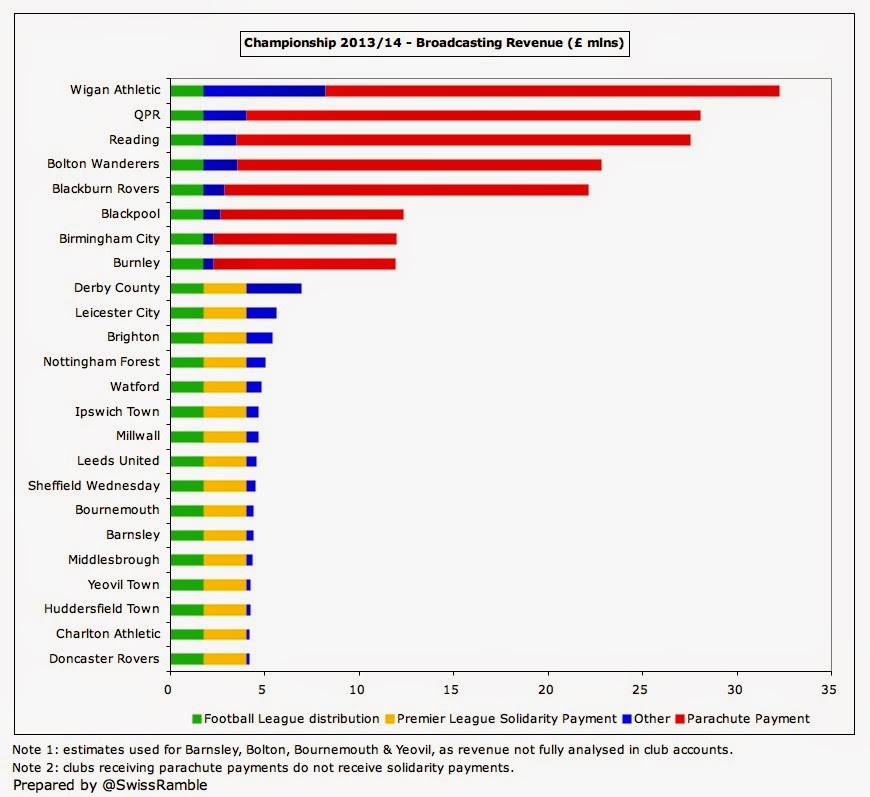

In 2013/14 QPR’s broadcasting revenue fell £14.7 million (34%) from £42.7 million to £28.1 million, including £24.1 million of parachute payments, though this was still the second highest in the Championship. Normally in that division clubs receive the same annual sum for TV, regardless of where they finish in the league, amounting to just £4 million of central distributions: £1.7 million from the Football League pool and a £2.3 million solidarity payment from the Premier League.

It should be noted that those clubs receiving parachute payments like QPR do not also receive solidarity payments. Other money is dependent on whether a team reaches the play-offs, cup runs and the number of times a club is broadcast live.


Looking at the Premier League television distributions, the massive financial inequality between England’s top two leagues becomes evident with Premier League clubs receiving between £62 million and £98 million in 2013/14, compared to the paltry £4 million in the Championship.

The value of the new Premier League television deal in 2013/14 can be seen by QPR “only” earning £40 million for finishing 20th (last) in 2012/13, which was £22 million less than the £62 million Cardiff City received when they claimed this dubious honour the following season.


QPR will have received a similar sum in 2014/15, but are now back to a life of parachute payments. These are currently worth £65 million over four seasons: £25 million in year 1; £20 million in year 2; and £10 million in each of years 3 and 4.

These will very likely increase in 2016/17 when the recent blockbuster Premier League TV deal comes into play, but so will the distributions in the top flight. My estimate is that the bottom club’s share will rise by £30 million to £92 million, while the year 1 parachute will only increase by £11 million to £36 million. This means that the gap to the Premier League would further increase: from £35 million (£62 million minus £27 million) to an amazing £54 million (£92 million minus £38 million).

This huge difference in revenue doesn’t quite excuse QPR’s profligacy, but it does explain it to a certain extent.


QPR’s match day revenue fell by £2.7 million (32%) from £8.3 million to £5.6 million in 2013/14 as ticket pricing was reduced “to reflect that we were playing in the Championship”. This was the 8th highest in that division, but this is not a great money spinner for any of the clubs playing at this level, e.g. only three earned more than £7 million: Brighton £10.4 million, Leeds United £8.6 million and Nottingham Forest £7.2 million.


Revenue was also impacted by QPR’s attendance dropping by around 1,100 from 17,779 to 16,656 (including more than 10,000 season ticket holders), which was the 9th highest in the Championship, way behind Brighton 27, 283 and Leeds United, Derby County and Leicester City (all around 25,000).

As might be expected, QPR’s attendances are higher when they compete in the Premier League, so have increased to 17,809 in 2014/15, but this is still the smallest in the top flight. To place this into context, it’s around 1,300 lower than Burnley, their fellow relegated team, despite the club’s claim that they are “confident that our pricing structure will help to encourage fans to attend.”


Part of the problem is the very low 18,489 capacity at Loftus Road, which is far from ideal for a club with aspirations of competing at the top level. It is therefore no surprise that the club has been looking to move to a new 40,000 seat stadium with the Old Oak Common site in north-west London being identified.

However, there is strong opposition from the site owner, Car Giant, coincidentally a former QPR sponsor, who stated that they had no plans for a football stadium in their development, so this would appear to be a non-starter. There is also the small matter of how the club would finance a new stadium. Interestingly, the accounts include £4 million spent on Rangers Developments Limited in the note on Related Party Transactions, though this is not explained.


QPR’s commercial income slumped badly following relegation, almost halving from £9.6 million to £5.0 million. This is maybe not that big a surprise, given that the club had previously stated that it “believes that its Premier League status will help it to significantly increase its commercial revenue.”

In fairness, £5 million is not too shabby in the Championship and is actually the 7th highest. It may be a long way behind Leicester City £19 million (boosted by a major marketing deal with Trestellar Limited) and Leeds United £12 million, but no other clubs manages to earn more than £8 million. Only the elite English clubs can earn vast sums commercially, but it must be galling to QPR that their near neighbours Fulham have managed to earn more than twice as much as them with £12 million.


QPR are currently in the third year of a shirt sponsorship deal with AirAsia, extended for the 2014/15 season, which was reportedly worth £2.5 million in the Premier League. If that figure is correct, then it compares favourably with clubs like West Ham and Stoke City, though it is obviously miles behind the deals for Manchester United, Arsenal, Liverpool, Manchester City and Chelsea. Nike are QPR’s kit supplier in a five-year deal running to May 2019.


What has really destroyed QPR’s finances is their unbelievable wage bill. Whichever way you look at this, it is fairly appalling. After promotion in 2012 it nearly doubled from £30 million to £58 million and then rose again the following season to £78 million. In the last four seasons the headcount has exploded from 104 to 169, including a 43 increase in the number of players, managers and coaches from 69 to 112.

Despite relegation the wage bill was only trimmed by £2.6 million (3%) from £78 million to £75.4 million, increasing the wages to turnover ratio from 129% to an almost unimaginable 195%. In other words, QPR spent twice as much on wages as their income – and then had to fund all their other expenditure.


Almost every club in the Championship has a dreadful wages to turnover ratio with 10 of them being more than 100%, but QPR’s is in a class of its own with the only clubs approaching a similar ratio being Bournemouth 172%, Nottingham Forest 165% and Millwall 132%.


In fact, QPR’s wage bill of £75 million was not only the highest in the Championship, but more than twice as much as the closest challengers, Leicester City, who managed to win the league on a wage bill of £32 million. The other promoted club, Burnley, somehow got by with wages of £15 million.

QPR stated that they operate “in a highly competitive market for talent and the market rates for transfers and wages is, to a varying degree, dictated by competitors.” There’s some truth in that, but let0s be honest: QPR’s wage bill is out of all proportion to their market (and indeed their performances on the pitch). Admittedly, the 2013/14 wages would have included promotion bonuses, but these are unlikely to be more than £5 million (based on the £4.6 million Crystal Palace paid the previous season).


To further emphasise the ridiculous nature of QPR’s wage bill, only seven clubs in the Premier League paid more than them in 2013/14. The good news is that the club appears to have learnt its lesson from the last time they went down, so most players’ contracts now include relegation clauses.


Another cost that has hurt QPR’s numbers is player amortisation, which has risen from £3 million in 2011 to £17 million in 2014, reflecting higher expenditure on player purchases. This represents the annual cost of expensing player purchases, as transfer fees are not fully expensed in the year a player is purchased. Instead, the cost is written-off evenly over the length of the player’s contract – even if the entire fee is paid upfront. As an example, Charlie Austin was bought from Burnley for a reported £4 million on a three-year deal, so the annual amortisation in the accounts for him is £1.333 million.


This might not sound much compared to some of the other large numbers in QPR’s accounts, but (stop me if you’ve heard this one before) it was still the highest in the Championship in 2013/14, around £10 million more than Blackburn Rovers £7 million.


There has been significant investment in the transfer market since Tony Fernandes arrived in 2011. In the last four years, QPR had a net spend of £68 million, which compared to just £14 million in the previous nine years. In the last accounts, Fernandes observed, “We have worked to put together a squad of players that we believe have the skill and ability to secure QPR’s place in the Premier League beyond this season.”

Although it has not exactly worked out as well as the club would have hoped, there is no doubt that the board has provided substantial financial backing to its various managers – though that was maybe not the best idea, especially when one of those is a certain Harry Redknapp, whose track record in helping to balance a club’s books leave a lot to be desired.


In fact, QPR have been one of the biggest spenders in the Premier League with only six clubs outspending them over the last four years, basically the usual suspects (Manchester United, Manchester City, Chelsea, Liverpool and Arsenal) plus West Ham.

The hope is that QPR will now do it differently with Fernandes claiming, “Our recruitment policy is changing. This is a new strategy for us. We want to develop a philosophy of buying young, hungry players who can go on to forge decent careers with us.”


All of this spending has been built on a mountain of debt, which has risen from £14 million in 2006 to £185 million in 2014, which is pretty shocking given that the club has spent two years in the Premier League since then. It’s not as if QPR has built a winning team or invested the money on improving infrastructure like a new stadium.

Incredibly, the figure would have been even higher at £250 million if the shareholders had not written-off £60 million and converted £5 million into equity (the maximum permitted by FFP rules) in 2014. Just pause for a moment and consider that: a quarter of a billion debt.

Most of the debt (£158 million) is owed to the club’s owners and is non-interest bearing, comprising £115 million to Tune QPR Sdn Bhd (a company controlled by Fernandes), £33 million to Sea Dream Limited (a company owned by the Mittal family) and £10 million to Amulaya Property Limited (a company entirely owned by Tune QPR and Sea Dream). However, in the last two years, the club has also taken on £27 million of bank loans, secured on the Loftus Road Stadium, which may be a cause for concern.

Another interesting point is that Sea Dream Limited only waived £6.6 million of the £60 million debt write-off, leaving the vast majority (£53.4 million) to Tune QPR Sdn Bhd, which is nowhere near the ownership proportions of Sea Dream 30% and Tune QPR 69%. It’s pure conjecture, but it would appear that Mittal was not overly keen to pay for Fernandes’ errors.


In the Championship only one club, Bolton Wanderers, had a higher debt than QPR at £195 million, with the next highest being Brighton £131 million and Ipswich Town £86 million. To further underline the magnitude of QPR’s debt, only two Premier League clubs had a higher balance: Manchester United £342 million (following the Glazers’ leveraged buy-out) and Arsenal £240 million (after building the Emirates Stadium).

In the last four years QPR had a cash outflow of £134 million from operating activities, but still spent £67 million (net) on player purchases. This was funded by an additional £191 million of shareholder loans, including £57 million in 2014 and £73 million in 2013, plus £27 million of new bank loans. The question is how much longer will the shareholders be prepared to put in such large sums with so little return (both on and off the pitch)?


It is also worth noting the feeble investment in long-term infrastructure with less than £7 million being spent on capital expenditure in the same period, despite all the fine talk of a new stadium and a new training complex at Warren Farm in Hanwell.

To add insult to injury, QPR are now facing the threat of a hefty Financial Fair Play fine from the Football League, who have queried the “treatment of certain items in their accounts”, namely the £60 million debt write-off. The FFP regulations would appear to rule out treating such a transaction as income, though QPR might argue that this particular write-off can be booked in this way, as the debt was not converted into equity (as is often the case).

Under the existing rules, clubs are only allowed a maximum annual loss of £8 million (assuming that any losses in excess of £3 million are covered by injecting equity). Any clubs that exceed those losses are subject to a fine (if promoted) or a transfer embargo (if they remain in the Championship). There is a sliding scale for the next £10 million of losses amounting to a £6.7 million fine, but beyond £18 million the fine is imposed on a pound-for-pound basis.

"Everything's Gone Green"

If the £60 million debt write-off is not allowed, that would imply an enormous fine of £58 million, though it has been suggested that deducting allowable expenditure like youth development and promotion bonuses would reduce that to £43 million. Either way it’s a huge amount of money that would set back QPR’s plans to bounce back to the Premier League at the first attempt. If they refused to pay, they could theoretically even be banished to the Conference.

However, QPR have challenged the legality of these rules. Their defence might include a number of factors, especially the fact that the Football League has already modified the rules that were applicable in 2013/14, while UEFA have also recently relaxed their version of FFP. Furthermore, it’s not as if QPR have tried to be particularly subtle about their accounting, unlike other clubs who have employed more “legitimate” means such as booking large impairment charges before relegation.

As always, Fernandes is expecting a favourable outcome: “I’ve always been very confident that a positive resolution will come out of the FFP case that is fair to everyone.” Even though those Championship clubs that have strived to stay within the rules might be unhappy, it would not be that big a shock if some form of compromise settlement on a lower sum would be agreed.

In many ways, QPR are fortunate to have Fernandes, who cannot be accused of under-funding the “project”, but to date he has given the impression of being one of those successful businessmen that seem to forget the strategies that have worked so well in their day job once they enter the world of football.

"Was it something that I said?"

Damned if you do, damned if you don’t, it could be argued, but it must be possible to spend so much money better than this. QPR’s owners are among the wealthiest in the world, but it may just be that the football club is way down their list of priorities. Despite the best of intentions, it is arguable that the club have not really made any progress since Fernandes turned up in 2011.

They are once again back in the Championship, though the chairman argued, “This time we go down in a much stronger position, with a better structure in place and better solutions to pursue what we want to do in the long term.” Certainly, there is the opportunity to rebuild with nine senior players out of contract at the end of the season and four loanees returning to their parent clubs, while a new, experienced chief executive, Lee Hoos, has been recruited from Burnley.

Of all people, Chris Ramsey the new head coach spoke sensibly about what needs to be done: “Everybody would want to bounce straight back into the Premier League and I am sure that’s what we’re going to try and do, but we have to be realistic. It’s important that everybody around the club realises that we have to get some stability and foundations in place to make sure that the future looks bright for Queens Park Rangers.”

That might not be particularly exciting, but some stability and a healthy dose of realism might be exactly what QPR need.

Tuesday, April 17, 2012

Queens Park Rangers - Hoop Dreams


This has been a pretty good season for teams promoted from the Championship with Swansea City and Norwich City attracting many plaudits, so it is a little strange that Queens Park Rangers have not received much praise, especially as they actually won that division last year, playing some thrilling football en route to the title. In many ways, this is understandable, as they have been involved in a relegation battle for much of the season, but there’s more behind the lack of warmth than results on the pitch.

For many years, QPR were well regarded by neutrals, not least in the 70s when a team featuring the mercurial talents of Stan Bowles, Gerry Francis and Dave Thomas finished runners-up in the old First Division, only losing out to Liverpool by a single point. However, a succession of deeply unsuitable owners has tarnished the club’s image over the years, even alienating sections of its own support.

This season alone, the club’s long-suffering fans have already seen yet another change in ownership, as Malaysian entrepreneur Tony Fernandes took control in August. This was not the end of the moves, as Neil Warnock, the manager who took QPR into the Premier League for the first time in 15 years, was dismissed in January to be replaced by Mark Hughes, a man who notoriously questioned Fulham’s lack of ambition when he left them after less than 12 months.

"Mark of success?"

Although Hughes is an easy man to dislike, he did manage to save Blackburn Rovers from relegation when they found themselves in a similar predicament to QPR, and three successive home wins against Liverpool, Arsenal and Swansea have given hope that he can repeat the trick at Loftus Road.

One advantage that he will have compared to previous QPR managers is an owner that seems willing to support him, not just financially, as seen by the relatively high spending in the January transfer window, but by providing the stability that has been missing at the club for the best part of a decade.

The previous owners had also been welcomed into the club when they arrived in November 2007, as they saved QPR from “certain administration.” The consortium included some seriously affluent individuals: Flavio Briatore, Renault’s Formula One team principal (worth £150 million); Bernie Ecclestone, the F1 supremo (worth around £2 billion); and Lakshmi Mittal, the steel magnate (Britain’s richest resident, worth north of £20 billion).

The initial purchase price of less than £20 million must have seemed like small change to them. Briatore paid £540,000 for 54% (later selling a 20% stake to Mittal for £200,000), while Ecclestone’s 15% holding cost £150,000. In addition, they covered £13 million of debt and pledged £5 million in convertible loans to fund player purchases.

"England is mine and it owes me a living"

Although some believed that the acquisition would deliver untold riches, this was far from the case, as Ecclestone was quick to clarify, “QPR isn’t a wealthy club. It’s a club that’s owned by some wealthy people. No-one is going to be lashing out loads of money.” Unlike Roman Abramovich at Chelsea and Sheikh Mansour at Manchester City, the owners did not pour big money into the club, though in fairness they did bankroll some hefty losses.

Their motivation for buying into QPR was never clear. In fact, Ecclestone admitted that he first thought that Briatore was offering him an opportunity to invest in a restaurant. Mittal is thought to have invested in order to please his son-in-law, Amit Bhatia, a keen football fan, who took the family’s seat on the board of directors.

However, the new owners slowly went from heroes to villains, with fans giving Briatore and Ecclestone the wonderful nickname, “Tango and Cash.” All was revealed to the world at large in the amazingly candid documentary, “The Four Year Plan”, which in particular painted Briatore as an irritable buffoon prone to interfering in team selection and tactics.

"Briatore and Ecclestone - it takes two to tango"

As one caretaker manager, Gareth Ainsworth, diplomatically explained, “He’s the chief investor and he loves taking an active part in how his investment is going.” That’s one way of putting it. Briatore’s desire to get involved resulted in the club going through no fewer than six managers (plus two caretakers), most of whom he described as “idiots” in the documentary.

The club’s reputation as a laughing stock was “enhanced” by a series of embarrassing episodes: Briatore threatening to sell the club if he did not receive the names of thousands of fans that heckled him at one game; the sight of supermodel Naomi Campbell sporting a QPR scarf, while appearing bored stupid in the directors’ box; and the club’s traditional badge being replaced by a tacky new version. At one stage, Briatore’s status as a “fit and proper person” to own a football club was brought into question following the F1 ban for his part in “crashgate”, when he was accused of instructing one of his drivers to seek advantage for the team by deliberately crashing.

Even last season’s promotion party was soured when QPR were found guilty of fielding a player, Alejandro Faurlin, who was owned by a third party, which was strictly forbidden after the Carlos Tevez affair at West Ham. Fortunately, the club was only fined, instead of suffering a points deduction, but it reflected badly on management, especially the controversial chairman, Gianni Paladini.

"Faurlin - Don't cry for me, Argentina"

Fans were equally dismayed at the lack of funds provided for transfers with Warnock complaining that he had only been given £1.25 million to strengthen the squad, but they were incandescent with rage at the massive rise in ticket prices that followed the elevation to the Premier League, which seemed like a real slap in the face to people that had stuck with the club through thick and thin.

This was just one of the decisions that led to Bhatia’s departure, though he was also unhappy at the removal of his friend Ishan Saksena as chairman. In addition, the rejection of his bid to buy out the partners must also have played a part in his reasoning. This was a blow to the club, as he had been one of the few to emerge from the documentary with any credit.

However, even though the broadcast was cringeworthy, it is important to note that they did actually deliver on the primary objective, namely promotion to the Premier League within four years. In fact, without the money that Briatore and Ecclestone put in, it is possible that the club might not be here at all. As Warnock said, “When they came in, the club was in a mess. We shouldn’t forget that altogether.”

"Anton Ferdinand - he's not heavy, he's my brother"

The truth is that QPR had been in financial difficulties ever since their relegation from the Premiership in 1996, which meant that they missed out on the boom years in the world’s most lucrative domestic league and were hit by the collapse of ITV Digital.

The club went into administration in 2001 under music mogul Chris Wright as it dropped into the third tier and were only saved by a £10 million loan from the mysterious ABC Corporation, a company registered in Panama, though this came at a price, as the interest rate was a whopping 11.76%. The annual charges of more than a million were crippling for a club whose 2003 turnover was around £7 million. It was also surprising that the loan was so high, as Wright was only paid £3.5 million in full settlement for his loans.

The injection of cash did help QPR secure promotion back up to the second tier, but the sting in the tail was that the lenders were also given the option to acquire the stadium (used as collateral to secure the loan) for £10 million if the club failed to repay the debt, even though it was valued at more than twice that amount.

"Paladini - suits you, sir"

Our old friend Gianni Paladini arrived in 2005, when he introduced Antonio Caliendo, like him a former football agent. Although Caliendo’s reputation was hardly unblemished, having been convicted of corruption in Italy, the club somehow managed to keep its head above water, albeit hit by numerous scandals, such as the memorable court case when seven men were acquitted in a court case after Paladini had alleged that he had been threatened at gunpoint before a match against Sheffield United.

Nevertheless, Paladini’s services were retained by Briatore, proving that he was supremely adept at the art of survival, if nothing else. The finances remained unstable, as seen by the auditors comments in the 2009 accounts, which noted, “the existence of material uncertainties regarding the group’s ability to continue as a going concern… unless sufficient funding (was) forthcoming.”

This was not the first example of the auditors expressing concern, as the accounts published for the 2004/05 financial year had been shown to be different from those approved at the annual general meeting.

These were symptoms of QPR’s underlying financial problems, amply demonstrated by the club’s growing debt, which rose from £14 million in 2006 to £56 million in 2011, including £22 million in the last 12 months alone. This was largely funded by various loans from shareholders, including £15.8 million from Sarita Capital Investments (believed to be a Briatore vehicle), £12.3 million from Sea Dream Ltd (a company owned by the Mittal family), £11.4 million from Ecclestone; and £10 million from Amulya Property Ltd (a company connected to Briatore and Bhatia).

The Amulya loan replaced the infamous ABC loan “at a more favourable rate of interest”, though it is worth noting that the interest rate was still on the high side at 8.5%, before being extended in 2010 at zero interest. It also still gave the lenders the option to acquire Loftus Road on the cheap in certain circumstances. More positively, the other shareholder loans were all made at zero interest with both Ecclestone and Mittal advancing a further £10 million apiece in 2011.

QPR had also used £4.9 million of their £5 million overdraft facility with Lloyds Bank, while £2.1 million of the debt was unexplained. As a technical aside, the analysis of net debt in Note 24 of the 2011 accounts does not equal the figures listed in the Creditors Notes (15 and 16), either in total or the split between debt due within one year and after one year.

Of course, this is all largely irrelevant, as Tony Fernandes and his partners have since bought a majority shareholding (66%) in the club. The Mittal family retained a 33% stake and Amit Bhatia was brought back as vice-chairman.

"Wright-Phillips - chip off the old block"

The purchase, reportedly costing £45 million in total, included the re-assignment of the loans made by Briatore and Ecclestone to Tune QPR Sdn Bhd, a company controlled by Fernandes, and the repayment of the bank overdraft. This was nowhere near the £100 million that the previous owners had been seeking, but largely covered the money that they had put in.

Bhatia confirmed that the gruesome twosome were no longer involved with QPR, “They have no ties with the club left. Balance sheet, debt, amounts owed – all of it.” That included ownership of the stadium. The takeover also resulted in Paladini’s eight-year association with the club ending three months later.

New chief executive Philip Beard announced, “The reality is that the club has no debt”, but he must have meant that it had no external debt, as the shareholder loans have simply been taken on by the new owners.

"Fernandes - come fly with me"

The arrival of Fernandes hopefully heralds a new dawn. The affable founder of Air Asia and principal of the Lotus Formula One team has a good business record and has already been much more communicative with the fans than his predecessors, making good use of his Twitter account. Although perceived as a nice guy, he is not afraid of taking tough decisions, hence his replacement of Warnock with a man he considered more likely to avoid the dreaded drop.

That said, QPR fans should not be expecting Fernandes to be a benefactor like Abramovich or Mansour, as he said, “I’m not someone who can whip out the cheque book like them. That’s Disneyland stuff. I’m not a sugar daddy. Maybe a sugar baby.” He continued, “This is not a black hole of Calcutta or a trophy asset. This has to be run as a business.” That might sound like pie in the sky, but he likened the situation in football to his other sporting experience, “I got into Formula One when the cost cutting came in. And you know, crazy budgets were slashed into much, real profits.”

The extent of his immediate ambition is to survive in the Premier League, which he deemed “realistic”. Bhatia added that they needed to achieve this aim “without throwing large amounts of money at it.”

This all sounds rather admirable, but Briatore said much the same thing after his arrival, “These deals will allow QPR to move towards our objective of ensuring that QPR is financially self-sufficient”, which was subsequently followed by three years of considerable losses.

This culminated in a deeply worrying £25.4 million loss in 2011 (in QPR Holdings Limited), which was £11.7 million (85%) higher than the previous year’s £13.7 million deficit, meaning that the club lost nearly £500,000 a week. It actually would have been £2 million worse without the reinstatement of a provision for a liability that was in place due to the sale of the club to a previous owner.

Unlike many clubs, the figures are not really impacted by profits on player sales, which were only £0.5 million last year. Indeed, the highest recorded in the last six years was only £2.1 million in 2008, largely as a result of the sale of Lee Cook to Fulham.

Clearly, these accounts are the last before the Fernandes takeover, so next year’s figures will be very different. In particular, promotion to the Premier League will mean significantly higher revenue (and expenses).

There’s certainly room for improvement, as it is ages since QPR achieved break-even. The losses really exploded in the Briatore/Ecclestone era with £58 million being racked up in the last three years alone. Even the relatively small 2008 loss of £6 million was artificially boosted by Caliendo waiving £4 million of his outstanding loans. Excluding this once-off factor, there would have been another double-digit loss in 2008 of £10 million. In fact, excluding all exceptional items, the total loss under the previous owners amounted to a colossal £70 million in four colourful years.

Of course, the vast majority of clubs in the Championship lose money with only three of the 24 contenders making money in 2010/11 (Watford, Scunthorpe United and Leeds United) and nine losing more than £10 million. This is partly a result of low TV money in England’s second tier, but also due to many clubs over-spending in order to reach the promised land of the Premier League.

QPR obviously managed to clear this hurdle, but their £25 million loss was by far the biggest in the Championship. As a comparison, Norwich City and Swansea City were also promoted, but made much smaller losses, £7 million and £11 million respectively.

The reason for QPR’s huge loss is blindingly obvious if we look at the factors behind their worsening deficit in the last five years, when the loss widened by £22 million from £3 million in 2006 to £25 million in 2011. In this period, revenue only grew by £7 million, but wages surged by £23 million. Other costs (£6 million) and player amortisation (£3 million) also increased, but the real damage was done by the booming wage bill.

Although QPR’s revenue grew 13% in 2011 from £14.4 million to £16.2 million, this was only mid-table in terms of the Championship. Leeds United were top of the tree with £33 million, due to very high gate receipts (thanks to Ken Bates’ ticketing policy) and a prosperous commercial operation. The next three clubs in the revenue league (Burnley, Middlesbrough and Hull City) all benefited from £15 million parachute payments after relegation from the Premier League.

Based purely on revenue levels, QPR did well to secure promotion, though Swansea’s achievement in doing the same on turnover of less than £12 million is even more remarkable.

One area where Briatore and Ecclestone should be applauded is the new commercial deals that they negotiated in 2009, which increased revenue by 60% from £9.2 million to £14.8 million. Even that pales into insignificance compared to the growth this season in the Premier League, when I estimate revenue will rise around 240% to £55 million, almost entirely due to the TV deal which should deliver at least £40 million on its own.

Unhelpfully, QPR stopped providing an analysis of their revenue after the 2008 annual report, so I have estimated the split since then using various assumptions. The accounts inform us that ticketing was 34% of total revenue in 2010 (42% in 2009), which would give £4.9 million match day revenue. Strangely, the same accounts also state that match day revenue is £2.5 million in the Business Review, but this seems very low. However, I have used the increment for this figure in the 2011 accounts of £0.4 million (£2.9 million less £2.5 million) as the basis for 2011 match day income of £5.3 million. This year assumes a 25% increase in the top flight.

The TV revenue is mainly per the distributions made to all clubs in the Championship, e.g. in 2010 this was £3.8 million, comprising central distribution of £2.5 million plus a £1.3 million solidarity payment from the Premier League. In 2011 this increase to £5.2 million, as the solidarity payment rose to £2.2 million and each club was given an additional £0.5 million as their share of the parachute payments for Newcastle and WBA, because they went straight back up to the top tier. The remaining TV money is for live broadcasts and progress in the cup competitions.

That just leaves commercial income as the balancing figure in years 2009 to 2011 with 2012 growth in the Premier League estimated at 25%, which does not seem unreasonable.

Of course, this season is all about the revenue from the Premier League’s TV deal. Many people refer to promotion being worth around £90 million, which is a little misleading, as it is not all received in one fell swoop, but it’s still a magnificent prize. Even if QPR do come straight back down, they would receive £40 million TV income plus £48 million parachute payments over the next four years (£16 million in each of the first two years, and £8 million in each of years three and four) plus additional gate receipts and commercial revenue.

Furthermore, if Rangers finish higher in the Premier League, they would receive even more TV money with every season survived adding another £40+ million to the coffers. Given the spectacular difference in revenue compared to the Championship, it is understandable why clubs like QPR push themselves to the absolute limit to secure promotion, though it’s a dangerous game, as only three clubs go up every year, leaving another 21 disappointed.

One concern is that the club might eat into that higher revenue by increasing wages and other costs, but the net effect is still likely to be positive. If we look at the three teams that were promoted to the Premier League in 2009/10, we can observe this phenomenon with Newcastle United, WBA and Blackpool, as all three clubs dramatically improved their operating profitability, even though wages increased.

Although £55 million revenue must seem like a huge sum to QPR, after averaging around £15 million for the last three years, it is still relatively low in the Premier League, e.g. only Blackpool and Wigan Athletic generated less revenue last season. For some perspective, QPR’s recent defeat to Manchester United was against a team whose £331 million revenue is six times as much as their own. As Sky used to say, “it’s a different ball game.”

Nevertheless, the allocation of TV money is reasonably equitable, ranging from £40 million to £60 million, with 50% of the domestic rights (£13.8 million) and 100% of the overseas rights (£17.9 million) shared out equally. Facility fees are allocated based on the number of matches shown live on TV (minimum of ten for each club), while the merit payment is worth £757,000 for each place.

Match day revenue of around £5 million is QPR’s real Achilles Heel. Clubs like Manchester United and Arsenal generate more revenue in just two games than QPR achieve in a whole season. This is partly down to Rangers’ low crowds with last season’s average attendance of 15,635 being only the 14th highest in the Championship.

This actually represented something of a recovery, as the previous season the average had only been 13,349. In fact, during the darkest days QPR’s crowds fell below 13,000. Although attendances have increased this season to over 17,000, this is still the smallest in the Premier League, even behind Wigan Athletic, whose crowds are notoriously low.

Part of the problem is the capacity at Loftus Road, which is only 18,360. This was one reason why QPR raised their prices so much following promotion, as the lovable Paladini explained, “QPR is a small ground, so we could not survive if we did not put prices up.” However, this did not make much sense, given the relatively small sums involved, especially as this increase understandably caused so much ill will among the supporters.

Season ticket prices were raised by around 40%, but the real increase was even higher, as there are four fewer matches in the Premier League, while match day prices doubled. This was the ghastly result of Briatore’s desire to create a “boutique stadium.” In fairness, most promoted teams do increase ticket prices, but this was excessive.

At least it presented Tony Fernandes with a PR open goal and he duly thumped the ball into the back of the net by quickly revising the pricing structure, so season ticket holders were given “significant” refunds; a cheaper match day pricing category was introduced; and under-eights were allowed in free of charge if accompanied by an adult.

Although Loftus Road can be an intimidating arena for visiting teams, it is far from ideal for a club with aspirations of competing at the top level. Given the current ground’s proximity to nearby housing, it would be too difficult to expand it, so a move to a new stadium has been mooted. Although it is not clear how this would be funded, Fernandes seems enthused by the idea and Philip Beard has emphasised its importance, “Football will be the bedrock of that stadium and a place where we can generate additional revenues from other activities so that the business plan for the club is sustainable.”

The club would like to stay close to where they are, as Fernandes explained, “It makes no sense to move out from where the fan base is.” Aided by the possibilities opened up by the BBC’s relocation to Salford and the massive Westfield shopping development, the club has reportedly identified three possible sites in the White City area.

However, the obvious question is whether Rangers would be able to fill a new stadium. Fernandes’ “gut feel” is for a 40,000 to 45,000 capacity, even though that would be more than twice the current attendance. That’s a big ask, especially with so many other teams on the doorstep.

"Running up that Hill"

Some of the costs might be reduced with a ground share, especially as QPR have plenty of previous here. Not only did Fulham share Loftus Road for two seasons between 2002 and 2004 while Craven Cottage was being redeveloped, but Wasps rugby union club also played home matches there for a while.

QPR’s commercial income of £5-6 million is not too bad, comparing favourably with many established top flight clubs like Bolton Wanderers and Blackburn Rovers, though it is only half of the £12 million generated by neighbours Fulham. Indeed, the club has stated that it “believes that its Premier League status will help it to significantly increase its commercial revenue.”

The previous owners had already demonstrated commercial acumen by making once-off payments in 2008 to extricate themselves from “poor value” sponsorship agreements with Car Giant and Le Coq Sportif. These were replaced by a three-year deal with Gulf Air worth £2.3 million a season and a five-year kit supplier agreement with Lotto Italia worth £20 million, which was a record for the Championship, though the full value would only be attained with promotion to the Premier League.

Last summer a joint shirt sponsorship deal was signed with Malaysian Airlines for the home kit and Air Asia for the away kit and third jersey for the next two years. The value was not divulged beyond a “multi-million pound deal”, though the respected Sporting Intelligence website estimated £2.3 million a year in line with the previous sponsor, while the Malaysian press estimated that it could be as much as £3 million. Beard said that “attracting two major Asian companies to come on board shows the global appeal QPR has as a brand”, though his argument is weakened by the fact they are both part-owned by Fernandes.

In any case, the money is not too bad at all, though it is still a fair bit less than the £20 million earned by Liverpool from Standard Chartered, Manchester United from Aon and (reportedly) Manchester City from Etihad. If the £4 million a season for the kit supplier are accurate, that’s even more impressive, e.g. it would be higher than Aston Villa’s new deal with Macron, but again it is small beer compared to the £25 million deals for Liverpool with Warrior Sports and Manchester United with Nike.

Of course, the burning issue at QPR has been the wage bill, which has more than quadrupled in the last five years, rising from £6.3 million in 2006 to £29.7 million in 2011. This has resulted in a dreadful wages to turnover ratio of 183%, significantly higher than UEFA’s recommend upper limit of 70%. To place that into context, big spending Manchester City’s ratio is “only” 114%.

In fact, QPR’s ratio has been above 100% in each of the last four years, which they partly ascribe to the imposition of transfer windows, claiming that this means they have to recruit a larger squad. In addition, the figures have been inflated by numerous termination payments to former managers.

While the wage bill looks awful, a couple of points should be acknowledged: (a) the 2011 figures have been inflated by bonus payments for promotion; (b) this is far from unusual in the Championship, where nearly half the clubs have a wages to turnover ratio over 100%.

Nevertheless, QPR’s wage bill of £29.7 million was easily the highest in the Championship last season (having pro-rated Middlesbrough’s figures, as their last accounts covered 18 months). Only three clubs in that division had a wage bill over £20 million, while QPR’s payroll was £11-12 million higher than the other two promoted clubs. Put another way, it was almost twice as much as clubs like Leicester City, Nottingham Forest and Leeds United.

However, before we stray too much into “shock, horror” territory, it was still a lot lower than every Premier League club in 2010/11 with the exception of Blackpool. Clearly, the wage bill will have increased this season with the likes of Joey Barton, Djibril Cissé and Nedum Onuoha being recruited on £60-80,000 a week, but this is unfortunately the price of dining at the top table. As the 2001 accounts put it, “The Group operates in a highly competitive market for talent and the market rate for transfers and wages is, to a varying degree, dictated by competitors.”

The other expense impacted by investment in the squad is player amortisation, which has been on the rise, but only reached £3.2 million in 2011. For those unfamiliar with this concept, amortisation is simply the annual cost of writing-down a player’s purchase price, e.g. Shaun Wright-Phillips was signed for around £6 million on a 3-year contract, but his transfer will only be reflected in the profit and loss account via amortisation, booked evenly over the life of his contract, so £2 million a year (£6 million divided by 3 years).

In this way, amortisation will rise significantly in the next couple of seasons in line with the recent higher expenditure in the transfer market. That said, QPR will still have a long way to go to match Manchester City’s £84 million.

Over the years, QPR have hardly been big spenders. Indeed, they had net sales proceeds of £1.2 million in the five years up to 2007. Only £14.8 million was spent during the four years under Briatore, as the club largely relied on free transfers and loans. Even in the promotion season, Warnock’s net spend was just £1.5 million.

However, things have changed since Fernandes’ arrival with £20.6 million being splashed out in the last two transfer windows, including £11 million in January alone on Bobby Zamora, Cissé and Onuoha plus loans for Samba Diakité, Federico Macheda and Taye Taiwo.

As the Malaysian said, “We have made a significant investment in relation to bringing new players to QPR.” In fact, only four clubs have spent more in that period (Chelsea, Manchester City, Manchester United and Liverpool), though Fernandes was at pains to emphasise that they had only been spent as much as “half a Man City player.” To an extent, the expenditure is predictable, as explained by Beard, “We are new to the Premier League. To stay up, we have had to invest in the squad.”

QPR’s balance sheet is not very robust with net liabilities of £40 million, having enjoyed net assets up to 2006 (as high as £10 million in 2000), though player values are under-stated in the books at £8 million, when their worth in the real world is much higher. The Transfermarkt website estimates the current value to be £70 million, taking into consideration the recent influx.

This deficit explains the need for support from the club’s shareholders and creditors, which is further demonstrated by the cash flow statement. In the last four years, this shows net cash outflow from operating activities of £47 million, rising to £68 million after interest payments and investment in players and infrastructure. This deficit required £64 million of new financing, made up of £30 million additional share capital and £34 million new loans.

It is therefore crucial that Fernandes and Mittal continue to provide support. Some concern has been expressed over the fact that Fernandes is not a QPR fan (he supports West Ham), though he did actually grow up in the area. Mittal could be seen as a somewhat reluctant owner, but Beard’s understanding is that the shareholders are “100% committed to this club in the short, medium and long term.” Bhatia has also said that his family “remains passionate about QPR.”

In any case, Fernandes has explained that apart from the emotional pull of owning a football club, he was also attracted by good, old-fashioned business reasons, especially QPR’s strength as a marketing vehicle for his companies. “Many people do not realise the power of sport to market a brand,” he said. “You can spend £40 million on advertising and have nothing like the same effect. Around the world, everybody watches Premier League football.”

Fernandes even believes that QPR could be profitable one day: “Yes, without a doubt. Otherwise I wouldn’t have got involved.” That makes sense, as he is reportedly worth “only” £200 million, which is big money for the likes of you and me, but does not go very far in high-level football. This is why he is so committed to the idea of the club finally paying its own way. As he neatly summarised, “It can’t be about one benefactor. I might be hit by a bus.”

"Shaun Derry - All cats are grey"

In the long-term, there are ambitious plans to build a new training ground, which would help improve the youth system. Fernandes said, “I’m keen to create a good academy, so that there’s a constant supply of players. We’re in a fantastic part of London and we should be bringing kids through.”

More immediately, the objective is clear, “The main thing is to avoid relegation.” Even though the blow would be softened by parachute payments, there would still be a tremendous financial hit, especially as it is rumoured that some top earners do not have relegation clauses in their contracts. Older fans would need no reminding that the last time that happened it took 15 years for QPR to get back...

Maintaining Premier League status for a couple of seasons would also provide some badly needed stability at the club, which might just loosen Mittal’s purse strings. Even if not, it would make QPR a more attractive opportunity for other investors.

"That's Zamora"

QPR fans have endured enough drama to last a lifetime, but there is potential here, especially under the guidance of Fernandes, who achieved a spectacular turnaround with Air Asia. When he bought that company, it was “a kind of unpolished diamond” with just two planes and a lot of debt, but he transformed it into a success story with 100 aircraft and profits of $400 million.

Could he achieve something similar at QPR? History would suggest not, but Fernandes has already beaten the odds once in his career, so it’s not impossible that West London’s version of Hoop Dreams could become reality. Westway to the World? Time will tell.

Related Posts Plugin for WordPress, Blogger...